How “wait” and “stay” differ
Many trainers keep these two cues apart so dogs don’t get confused.36
This is a convention trainers like to use, not a fixed rule. What matters is that everyone at home uses the same word to mean the same thing.
Why train with rewards
The American Veterinary Society of Animal Behavior (AVSAB) states that the evidence supports reward-based training for every kind of dog training, and that there is no evidence painful or frightening methods are needed, such as choke or prong collars, shock collars, shouting or jerking the lead.1
A study of 92 dogs from 7 training schools in Portugal found that dogs trained with aversive methods showed more stress behaviours and a bigger rise in stress hormones after training.4 Another study comparing recall training in 63 dogs found reward-based training worked at least as well as e-collars.5 Both studies have design limits, but the results point the same way as AVSAB and the RSPCA, who advise short, regular, reward-based sessions.17
Step by step
Have small treats your dog loves, pick a quiet room, and train in short sessions several times a day.7 The method below is based on guidance from the AKC and VCA.26
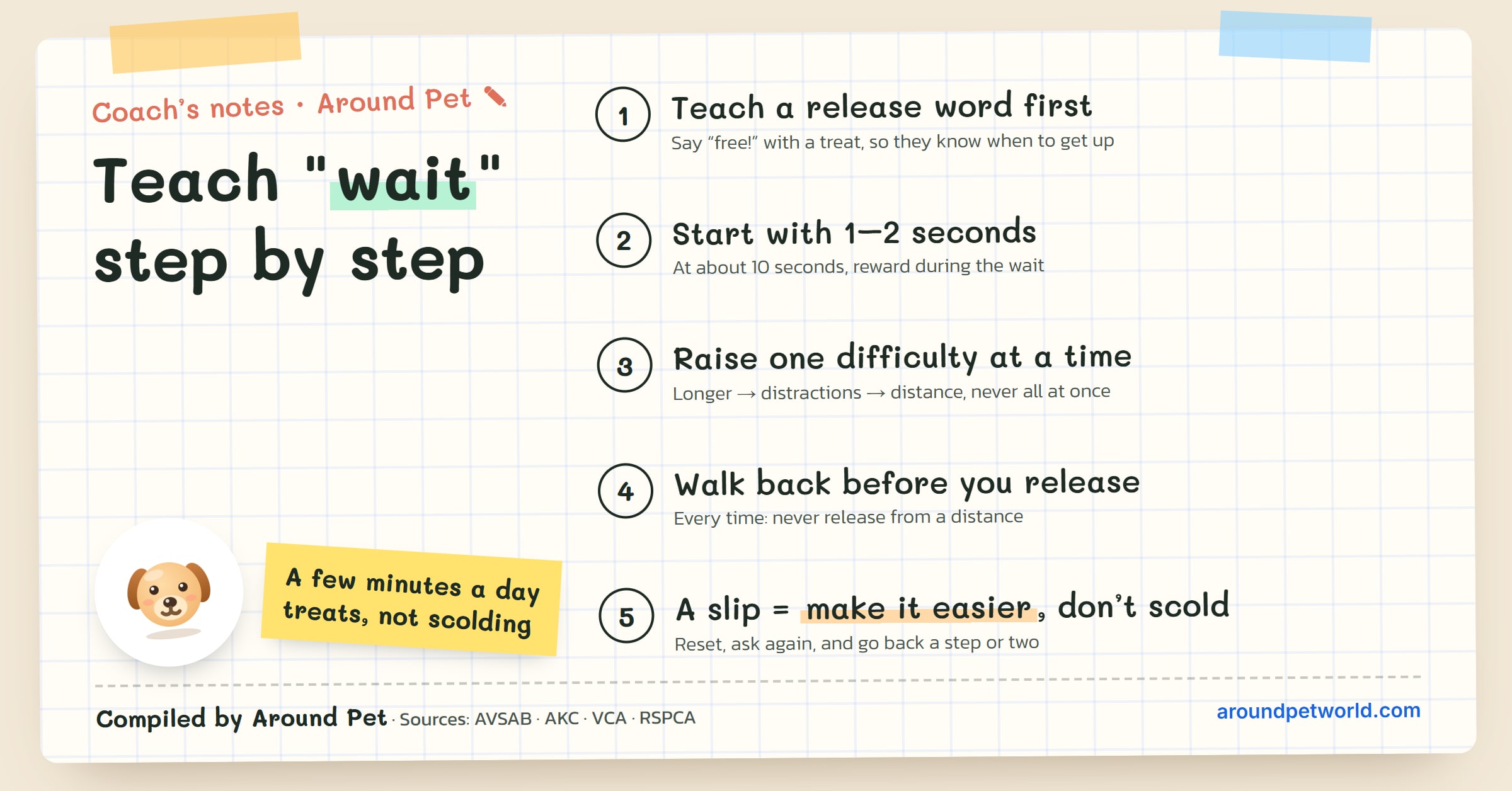
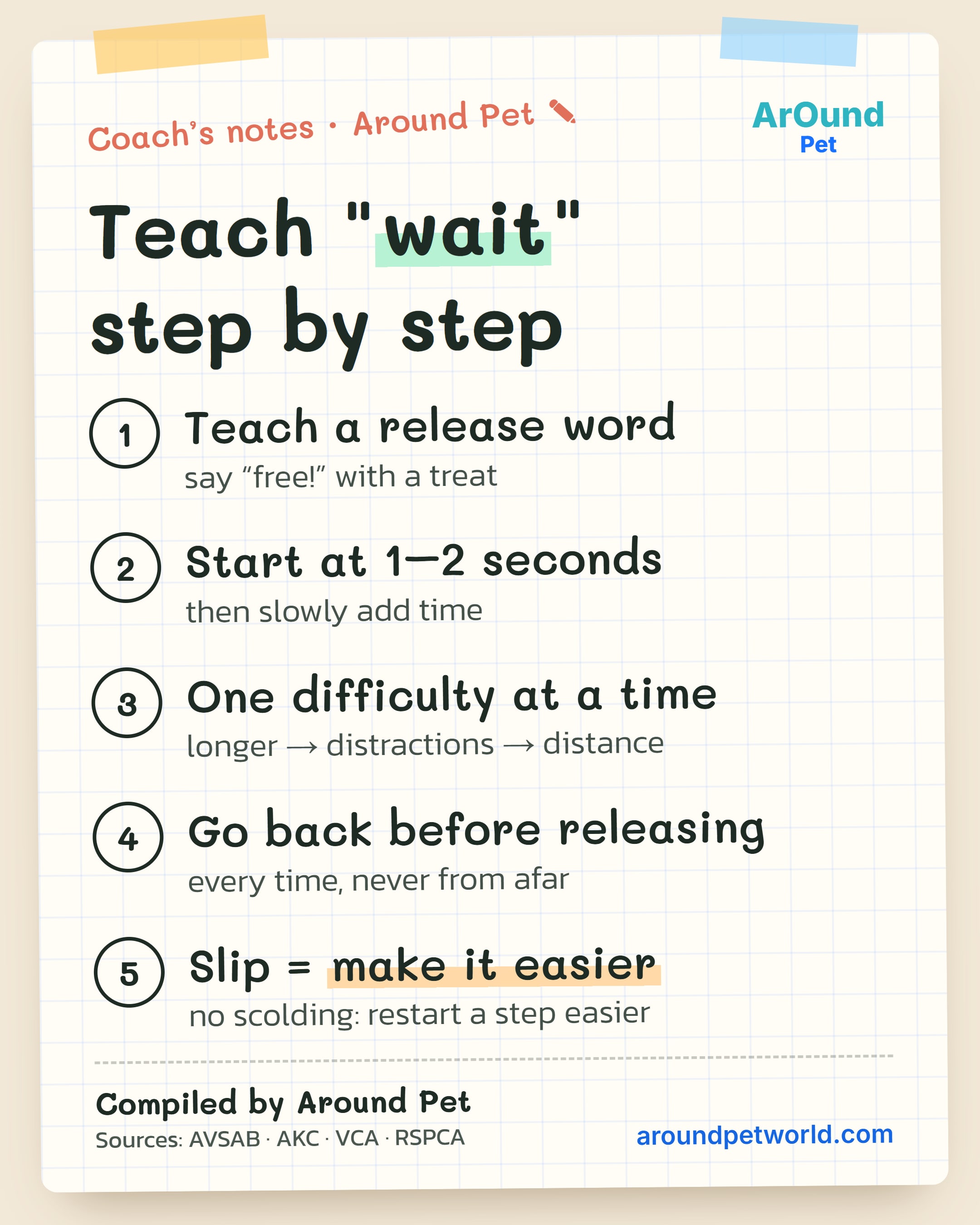
- Teach a release word firstPick a short word such as “free” or “okay”. Ask for a sit, wait a second, then say the release word as you give a treat and invite your dog to move. They learn that this word means they can get up.2
- Start with 1–2 secondsAsk for a sit or down, show a flat palm as a hand signal with the cue, wait just 1–2 seconds, reward, then say the release word.2
- Build up the timeOnce your dog can wait about 10 seconds, reward them at intervals during the wait.2 Sometimes reward right away and sometimes later, so they learn that waiting is normal.6
- Add distractionsOnly once your dog can wait about 30 seconds, start adding distractions such as tapping a table or someone walking past, and shorten the wait each time you add a new one.2
- Step back one pace at a timeTake one step back, then walk back to your dog, reward, and only then say the release word. Always go back to your dog before releasing.2
Waiting at the door
A wait at the door stops your dog dashing out into traffic or getting lost, and makes it safer to carry things in and out of the house.3
- Open the door just a crackIf your dog moves towards it, gently close it again. If they stay put, reward, then open it a little wider.
- Add the cueOnce your dog understands, start saying “wait” before opening the door.
- Step into the doorway, then walk throughReward while your dog keeps waiting. Some rounds, release them out with a toy as the reward; other rounds, just come back and give a treat without releasing.
Start with doors inside the house. At the front door, always keep your dog on a lead, then practise at the crate door and the car door too.3
Common mistakes
- Walking backwards away from your dog, which invites them to follow2
- Making it harder too fast, or adding several things at once2
- Releasing from a distance, or letting your dog release themselves2
- Saying the release word by accident in everyday talk2
- Rewarding the release more than the wait2
- Giving the cue when your dog is stressed or very excited6
When puppies can start
VCA suggests starting “sit” and “come” from about 7–8 weeks, and “stay” and “leave it” from about 3–4 months, and it may take many more months before a puppy follows cues reliably.68 If you join a puppy class, choose one that uses rewards and requires vaccination before joining.8
When to get help
If your dog has a serious behaviour problem, such as aggression, strong fear or anxiety, talk to a vet, a veterinary behaviourist or a qualified animal behaviourist, as it may need changes to the environment, behaviour modification and sometimes medication.17
Compiled by Around Pet
This article was written afresh by the Around Pet editors from the sources below, as general information for pet owners. If your dog’s behaviour worries you, please talk to a vet or an animal behaviour specialist.
Sources
- American Veterinary Society of Animal Behavior (AVSAB) Position Statement on Humane Dog Training (2021)
avsab.org/…/AVSAB-Humane-Dog-Training-Position-Statement-2021.pdf - American Kennel Club (AKC) How to Teach Your Dog to Stay
akc.org/expert-advice/training/teach-your-dog-to-stay - American Kennel Club (AKC) How to Teach Your Dog to Wait at Doorways
akc.org/expert-advice/training/teaching-wait-at-the-door - Vieira de Castro, A. C. et al. Does training method matter? Evidence for the negative impact of aversive-based methods on companion dog welfare. PLOS ONE 15(12), 2020
pmc.ncbi.nlm.nih.gov/articles/PMC7743949 - China, L., Mills, D. S. & Cooper, J. J. Efficacy of Dog Training With and Without Remote Electronic Collars vs. a Focus on Positive Reinforcement. Frontiers in Veterinary Science 7:508, 2020
frontiersin.org/…/10.3389/fvets.2020.00508/full - VCA Animal Hospitals Puppy Behavior and Training: Sit, Down, Stand and Stay
vcahospitals.com/know-your-pet/puppy-behavior-training--training--sit-down-stand-and-stay - RSPCA How to Train Your Dog & Top Training Tips
rspca.org.uk/adviceandwelfare/pets/dogs/training - VCA Animal Hospitals When should you start puppy classes?
vcahospitals.com/pediatric/puppy/behavior-training/when-to-start-puppy-training-classes - American Veterinary Society of Animal Behavior (AVSAB) Position Statement on the Use of Dominance Theory in Behavior Modification of Animals
avsab.org/…/Dominance_Position_Statement-download.pdf