What to bring
A checklist before you leave home
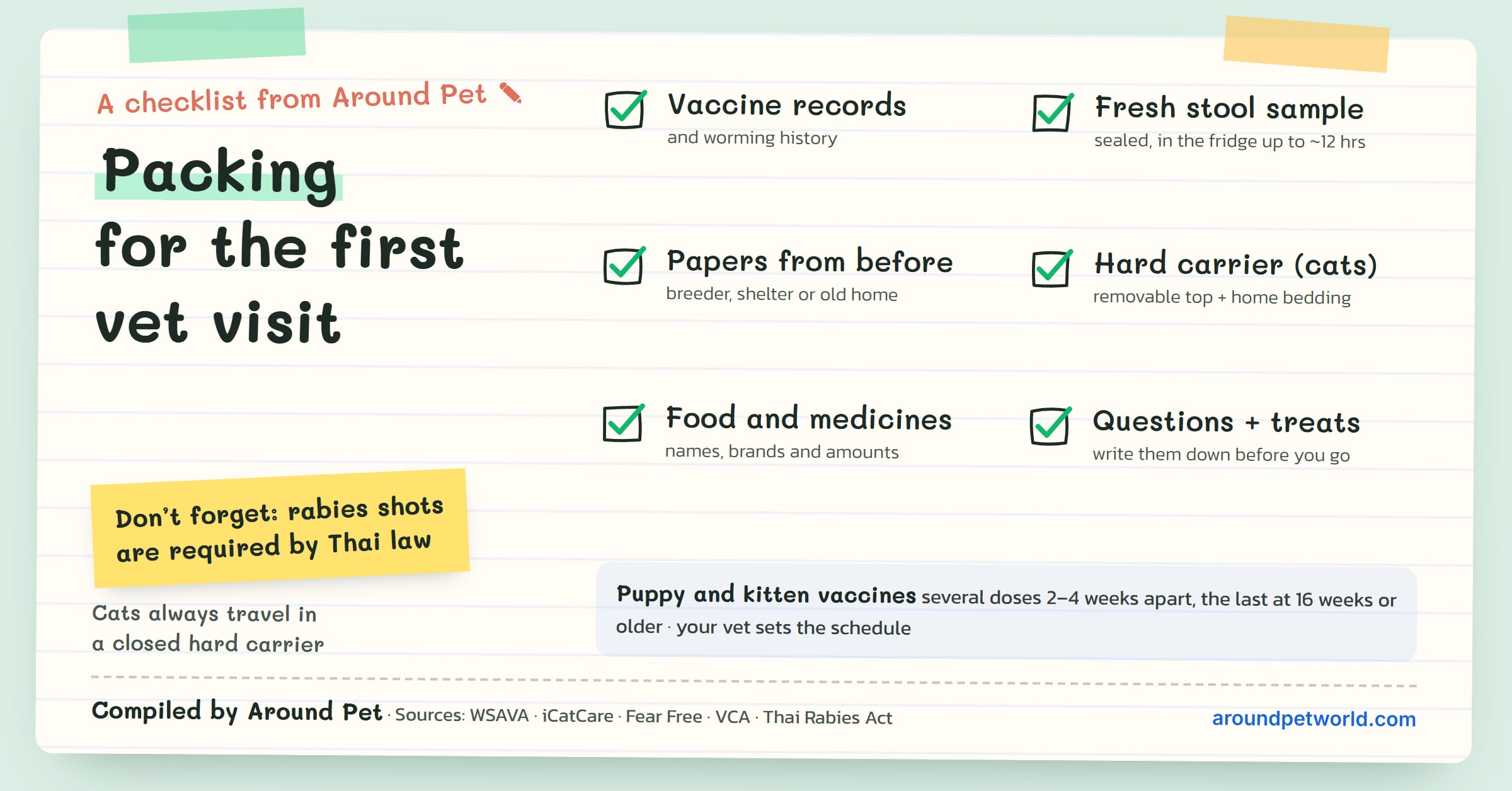
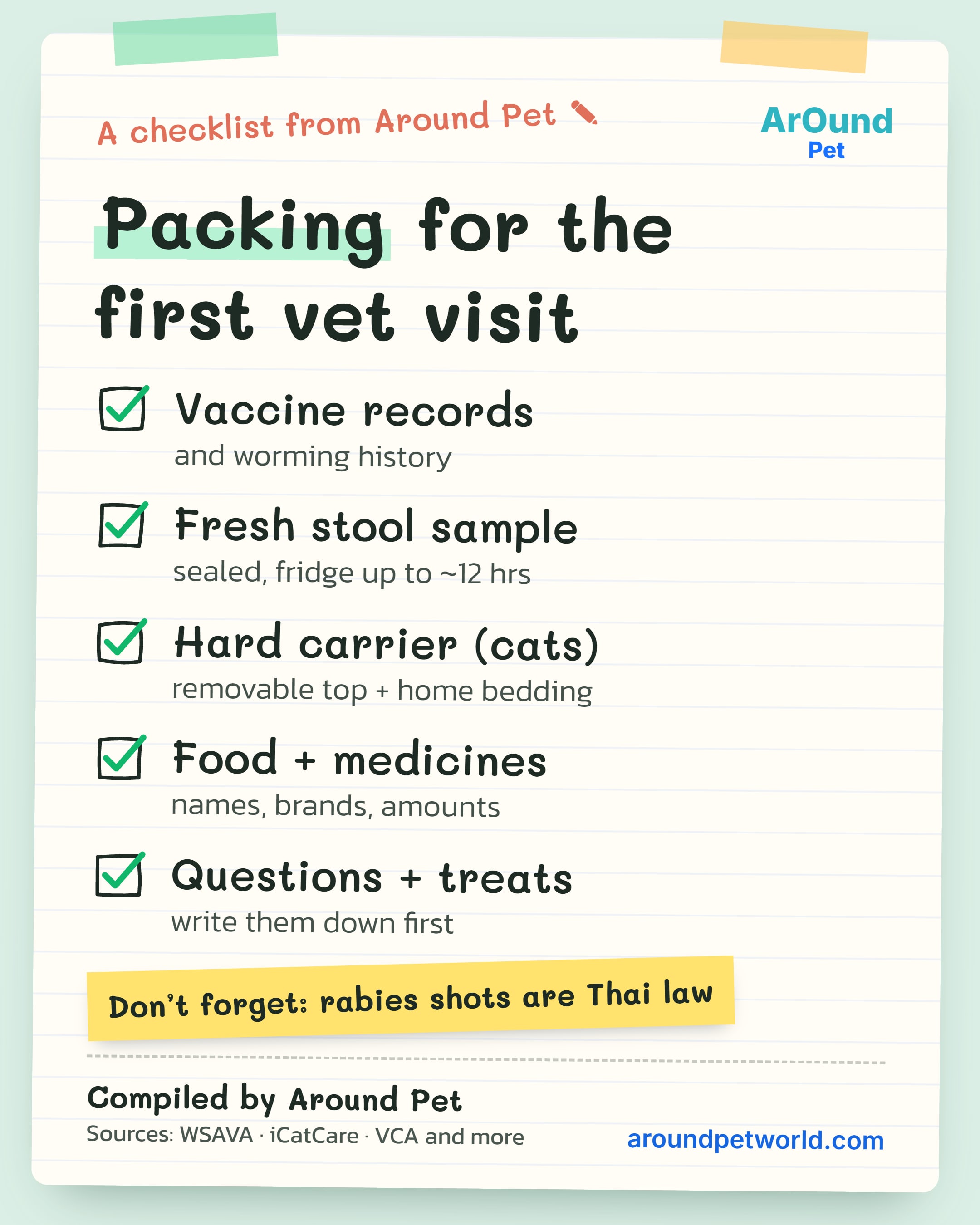
- Papers from the breeder, shelter or previous home4
- Vaccination and worming records4
- A fresh stool sample in a sealed bag45
- A hard carrier for cats, with bedding that smells of home23
- The name and brand of their current food
- Any medicines or supplements they take
- A lead or harness for dogs
- Small treats they love, and your written questions
Medical records help the vet decide which vaccines, tests or parasite prevention your pet still needs.4 A stool sample lets them check for worms you can’t see, which even healthy-looking young animals can carry. Collect it in an inside-out bag, seal it, and keep it in the fridge for no more than about 12 hours: the fresher the better.4 If you see tapeworm segments in the stool, tell the vet too.5
Taking a cat to the vet without the stress
Cats should always travel in a carrier, because a harness or collar alone isn’t safe in a car.2 A hard plastic carrier is safest and easiest to clean. Choose one with a removable top, so the vet can examine your cat while they stay in the base. Each cat should have their own carrier.23
Make the carrier a safe place
- Keep the carrier out at homeDon’t store it away and bring it out only on vet day. Leave it in a spot your cat likes, with familiar bedding and treats.23
- Let your cat walk inIf you do need to put them in, be gentle. If your cat is very frightened, wrap them in a familiar towel first.23
- Build up step by stepFrom resting on bedding in the carrier to the carrier being lifted, let your cat be comfortable at each step before moving on.2
Some clinics suggest spraying a cat calming pheromone on the bedding at least 15 minutes before setting off.23 If you’re interested, ask your vet whether it suits your cat.
What happens in the exam room
A first check-up usually starts with paperwork, a temperature check and weighing. Then the vet checks eyes, ears, skin and coat for parasites, listens to the heart and lungs, and looks at the teeth. Vaccines may be injected or given as nose drops, and parasite treatment depends on the stool test. You’ll book the next appointment before you leave.4
- Worming is repeated in rounds, because treatment only kills adult worms, and larvae grow into adults in about 3–4 weeks.5
- A microchip is the most recommended form of ID: it goes under the skin and links to a registry.5
- Neutering: the right timing depends on your pet, so ask your vet.5
For puppies, VCA suggests the first check-up at about 6–8 weeks, when vaccines and parasite prevention begin.5
Core vaccines to know
The World Small Animal Veterinary Association (WSAVA) splits vaccines into “core” vaccines every animal should have and “non-core” vaccines that depend on lifestyle and location.1
| Core everywhere | Core where the disease occurs | |
|---|---|---|
| Dogs | Canine distemper · infectious hepatitis (adenovirus) · parvovirus | Rabies · leptospirosis |
| Cats | Feline panleukopenia · calicivirus · herpesvirus (cat flu) | Rabies · leukaemia (FeLV) for kittens and cats who go outdoors |
Immunity passed on from the mother interferes with vaccines in young animals, so they need several doses 2–4 weeks apart, with the last at 16 weeks or older and a booster at 26 weeks or after. Adult animals shouldn’t get core vaccines more often than needed, because immunity often lasts a long time.1
Rabies under Thai law
Thailand’s Rabies Act B.E. 2535 (1992) requires owners to have controlled animals vaccinated by a vet or an authorised person. For dogs, the first dose is given after 2 months and no later than 4 months of age, then as scheduled on the certificate. After each dose you receive a tag and a vaccination certificate. Your pet must wear the tag, and if you lose it you must get a new one within 15 days.6 Cats were added as controlled animals by a regulation in 2017.7
Questions to ask the vet
Time in the exam room goes fast, and writing questions down in advance helps you not to forget. Some questions the editors suggest:
- Which vaccines does my pet need, and when is the next dose?
- What should I use against worms, ticks and fleas, and how often?
- Is their current food right, and how much should they eat a day?
- When should they be neutered, and can they be microchipped now?
- Which signs mean I should bring them in straight away?
Compiled by Around Pet
This article was written afresh by the Around Pet editors from the sources below, as general information for pet owners. It is not a diagnosis or treatment advice. Please ask your vet about your own pet’s vaccines and care, and note that laws may change.
Sources
- WSAVA Vaccination Guidelines Group 2024 Guidelines for the Vaccination of Dogs and Cats
wsava.org/…/2024-Guidelines-for-the-Vaccination-of-Dogs-and-Cats.pdf - Feline Veterinary Medical Association (AAFP/ISFM Cat Friendly) Visiting Your Veterinarian: Getting your Cat to the Veterinary Practice (2024)
catvets.com/…/FelineVMA_VisitingYourVet_Web.4.pdf - International Cat Care Taking your cat to the vet (2025)
icatcare.org/articles/taking-your-cat-to-the-vet - Fear Free Happy Homes Your Puppy's First Veterinary Visit: What to Know
fearfreehappyhomes.com/?p=11784 - VCA Animal Hospitals Puppy: Recommendations for New Owners, Part I: Veterinary Care (2026)
vcahospitals.com/know-your-pet/puppy---recommendations-for-new-owners-part-i---veterinary-care - Ministry of Agriculture and Cooperatives (Thailand) Rabies Act B.E. 2535 (1992), English translation
moac.go.th/db-law_agri-files-431091791797 - Thairath พ.ร.บ.โรคพิษสุนัขบ้า เจ้าของสุนัข-แมว ควรต้องรู้ [The Rabies Act: what dog and cat owners should know] (legal column, 2018)
thairath.co.th/news/local/1232716