1. Start with “complete and balanced”
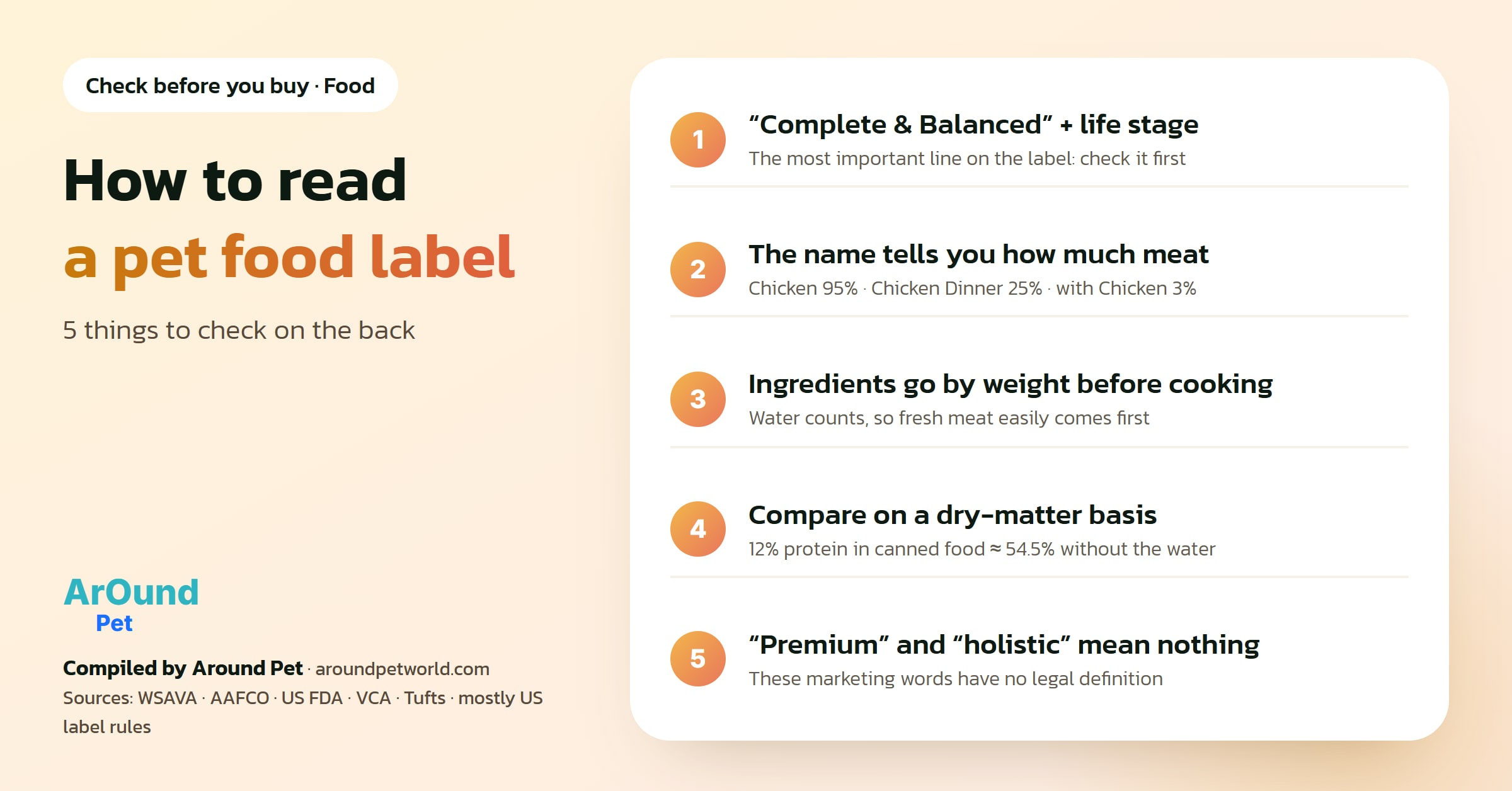
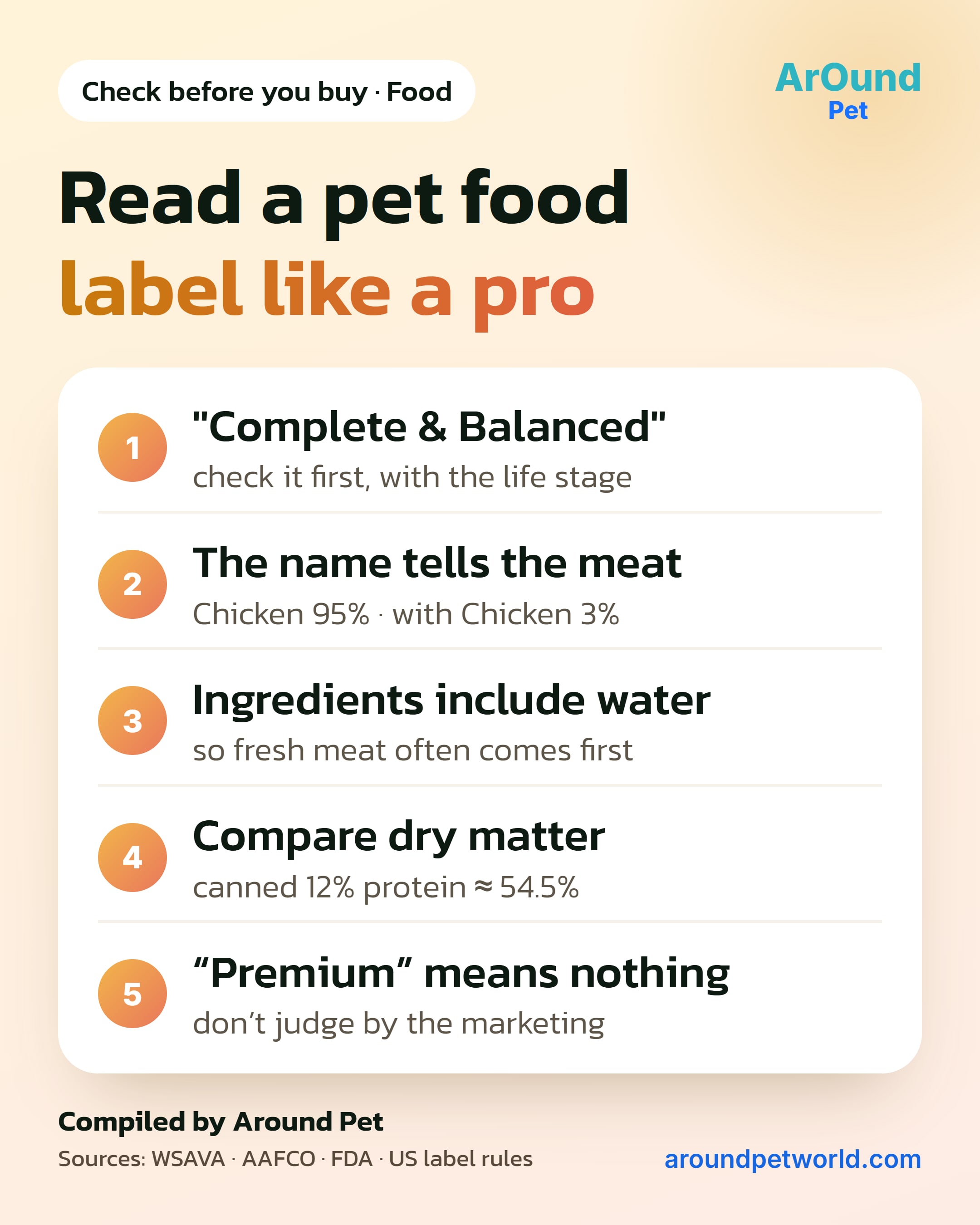
AAFCO and VCA agree that the nutritional adequacy statement is the most important part of the label.26 A food labelled “complete and balanced” is meant to be your pet’s only food, and must meet one of two tests: its recipe matches an AAFCO nutrient profile, or it passed an AAFCO-protocol feeding trial with real animals.23
- Check the life stage too, such as growth, adult maintenance or “all life stages”. All-life-stages recipes meet the levels set for young animals and pregnant mothers.12
- Foods labelled “complementary” or “intermittent” should make up no more than about 10% of the diet.1
- Seals or logos from other bodies don’t prove a food is nutritionally complete.3
For puppies and kittens, Tufts’ animal nutrition specialists prefer foods tested in feeding trials over foods that are only formulated to meet the profile.68
2. The product name tells you how much meat
Under US rules, the words in a product’s name have a set meaning. “Chicken”, “Chicken Dinner” and “with Chicken” contain very different amounts of chicken.2
| Name format | The named ingredient must make up at least |
|---|---|
| “Chicken” (on its own) | 95% of the weight without added water (70% counting water) |
| “Chicken Dinner / Entrée / Platter” | 25% without water (10% counting water) |
| “with Chicken” | 3% |
| “Chicken Flavor” | No set amount; it only needs an ingredient that gives that flavour |
3. The ingredient list
Ingredients are listed from heaviest to lightest,24 but that weight is counted before cooking and includes water. Fresh meat, which is mostly water, can come first even if grains make up more once it is dried.6 One source ingredient can also be split into several entries.8
WSAVA and Tufts both warn that the ingredient list tells you very little, about either the quality of the ingredients or the actual nutrients.18
4. The guaranteed analysis
A US-style label must show at least four values: minimum protein, minimum fat, maximum fibre and maximum moisture.2 These figures are limits, not exact values. For more precise numbers, ask the maker for the “typical analysis”.16
Comparing wet and dry food fairly
Wet food is mostly water, so its protein figure looks low. Convert to dry matter before comparing, using nutrient % ÷ (100 − moisture %) × 100. An example from the FDA:3
12 ÷ 22 × 100≈ 54.5%
37 ÷ 88 × 100≈ 42%
So the canned food that looks lower in protein on the label actually has more protein on a dry-matter basis.
5. Calories and how much to feed
In the US, labels must state calories in kilocalories per kilogram and per familiar unit, such as per cup or per can.2 Many countries don’t require this. If it isn’t on the label, ask the maker.1
The feeding guide on the bag is based on averages, so treat it as a starting point and adjust to your pet’s body shape with your vet.67
6. Marketing words with no legal definition
WSAVA notes that words like “holistic” and “premium” have no regulated meaning and do little to help you decide.1 Words such as “new” or “proven” come with conditions under AAFCO rules.2 A food that claims to treat or prevent disease may count as an unapproved drug under US rules.4
7. About grain-free food
The FDA investigated reports of dilated cardiomyopathy (DCM) in dogs. Most reports involved grain-free foods and foods with peas or lentils, but the FDA states it has not shown that these foods are the cause, and genetics may play a part too.5 Tufts adds that grains are well digested, and many grain-free recipes simply use other refined starches instead.8
8. Questions to ask the maker
WSAVA suggests these questions, and if a company won’t answer, be wary of that brand.1
- Do they employ a qualified animal nutritionist?For example a PhD, or a board-certified specialist in animal nutrition.
- Who formulates the recipes?And are they tested in a lab, or only calculated from a database?
- How do they control quality?Of both ingredients and the finished product.
- Have they published research?And can they provide a typical analysis and contact details?
Tufts adds some warning signs: claims that can’t be checked, research that is cited but can’t be shown, and advertising that attacks competitors.8
Compiled by Around Pet
This article was written afresh by the Around Pet editors from the sources below, as general information for pet owners. It is not personal nutrition advice. If your pet has a health condition or needs a special diet, please talk to a vet.
Sources
- WSAVA Global Nutrition Committee Guidelines on Selecting Pet Foods (2021)
wsava.org/…/Selecting-a-pet-food-for-your-pet-updated-2021.pdf - AAFCO Reading Labels
aafco.org/consumers/understanding-pet-food/reading-labels - U.S. Food & Drug Administration (FDA) "Complete and Balanced" Pet Food (2020)
fda.gov/animal-veterinary/animal-health-literacy/complete-and-balanced-pet-food - U.S. Food & Drug Administration (FDA) Animal Food Labeling and Pet Food Claims (2026)
fda.gov/animal-veterinary/animal-foods-feeds/animal-food-labeling-and-pet-food-claims - U.S. Food & Drug Administration (FDA) FDA Investigation into Potential Link between Certain Diets and Canine Dilated Cardiomyopathy (2022)
fda.gov/…/fda-investigation-potential-link-between-certain-diets-and-canine-dilated-cardiomyopathy - VCA Animal Hospitals Deciphering Dog Food Labels (2025)
vcahospitals.com/know-your-pet/deciphering-dog-food-labels - VCA Animal Hospitals Should You Follow Pet Food Label Serving Sizes?
vcahospitals.com/resources/preventive-dog/nutrition/… - Tufts Cummings School of Veterinary Medicine Nutrition FAQs
vet.tufts.edu/…/nutrition/nutrition-faqs