A rabbit’s cute face and small size lead many people to think a little cage in the corner of a room is enough. But rabbit welfare organisations around the world agree that rabbits need space, company and the right food just as much as dogs and cats do. Before you bring one home, check you’re ready for these.
More space than you think
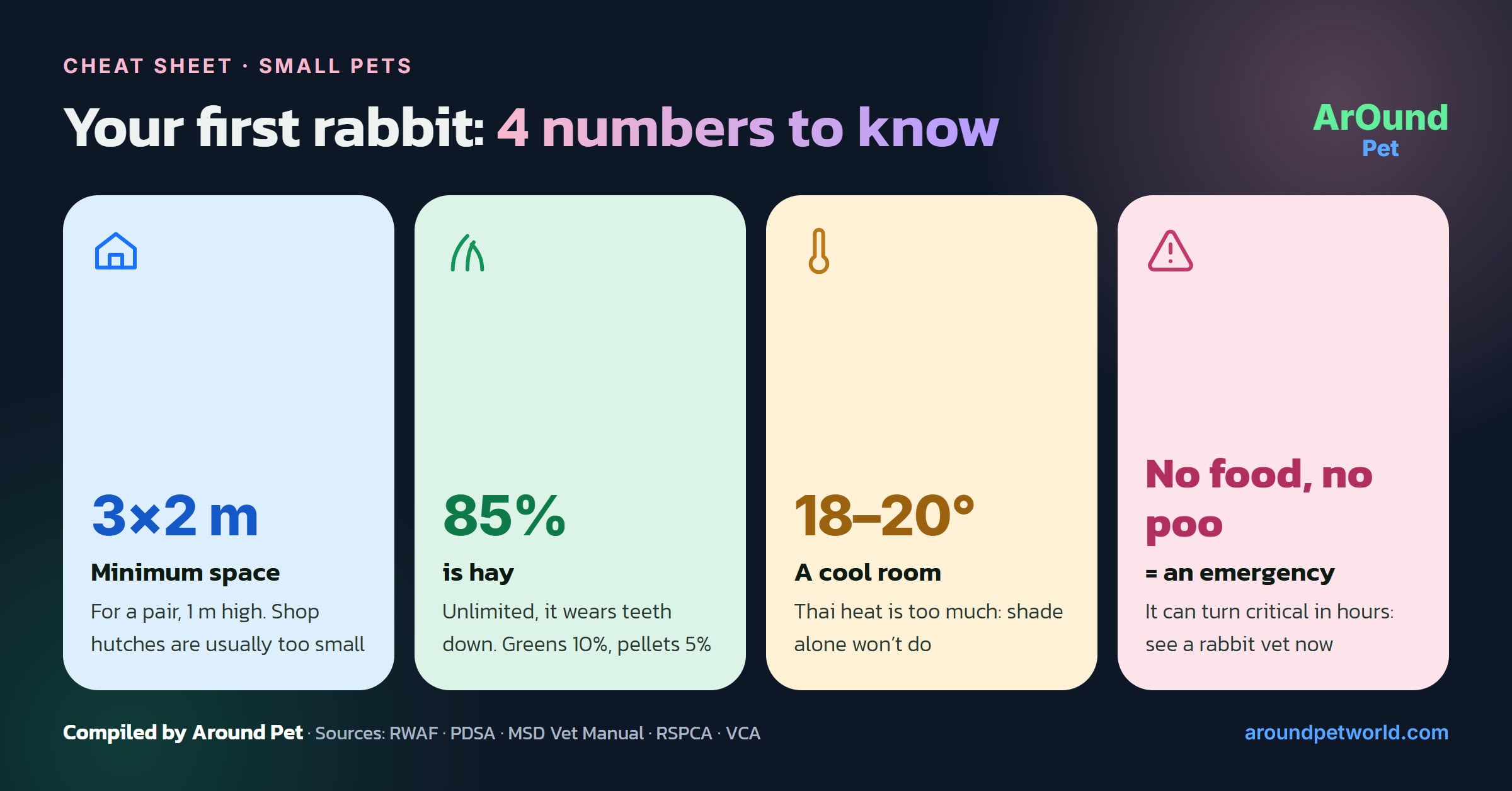
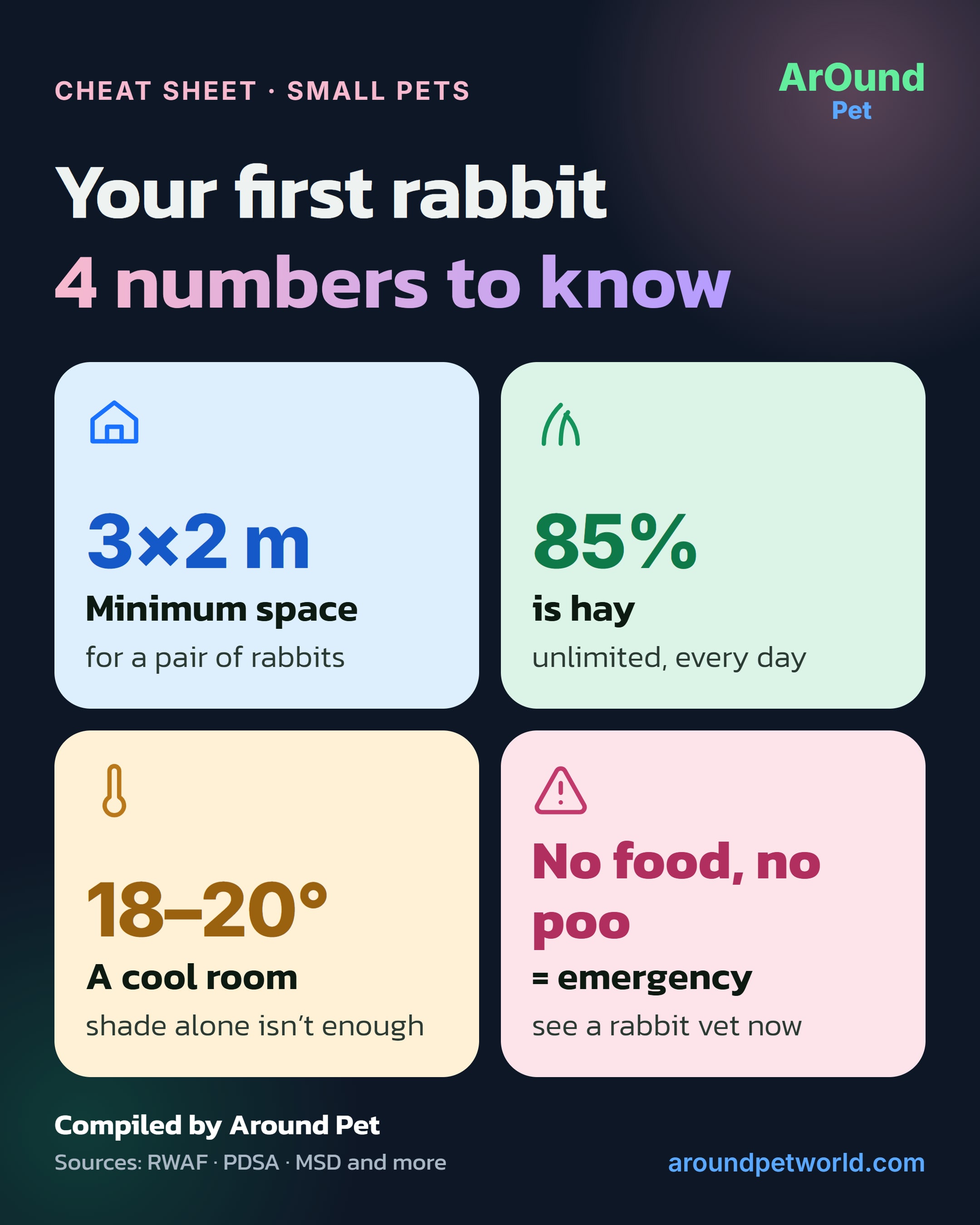
The UK’s Rabbit Welfare Association & Fund (RWAF) recommends a minimum of one connected area at least 3 × 2 metres and 1 metre high, which can include the sleeping quarters.1 RSPCA Australia gives the same figure for a pair of medium-sized rabbits, and warns that most hutches sold in shops are too small.2
Indoors, give them hiding places with two exits, and one litter tray per rabbit plus a spare.2 If they roam a room, lay non-slip mats, because shiny tiles or wooden floors make rabbits slip easily.1 Use food and water bowls heavy enough not to tip over.5
Rabbits don’t like being alone
Rabbits are social animals, so another rabbit for company matters for their wellbeing. The most recommended pair is a neutered male and a neutered female.13 To pair two rabbits, have both health-checked first, then introduce them step by step.3
- Swap scents firstSwap cloths or belongings between the two so they get used to each other’s smell.
- Side by side, with a barrierLet them see and smell each other without sharing a space yet.
- Meet on neutral groundSomewhere neither rabbit sees as their territory.
- Move into one homeOnce they can be together calmly.
This usually takes several weeks: a few days for some pairs, months for others.3
Food: hay is the hero
Rabbit teeth grow throughout life, and chewing high-fibre hay is what wears them down just right. Pellets don’t do this.5 The RWAF recommends this daily mix.4
- Choose grass hays such as timothy, oat or orchard. Alfalfa isn’t suitable for adult rabbits. Pick plain, timothy-based pellets.5
- Always have fresh water available.5
- Fruit is an occasional treat.5 Carrots are high in sugar too, so give only a little: they aren’t a staple like in cartoons.6
Toilet and chewing
Litter training
Put the tray where your rabbit already likes to go, add a few of their droppings, and put hay beside the tray, because rabbits like to eat and toilet in the same place.17 Good litters are paper-based, hay or straw. Avoid wood shavings, clay litter and clumping cat litter, because if eaten they can block the gut.57 Neutered rabbits are usually easier to train.7
Chew-proofing your home
Chewing is a natural need that keeps teeth in shape, so rabbits chew door frames, skirting boards, furniture and carpets.1 Cover every cable with chew-proof tubing, and offer hay, cardboard boxes or untreated wood to chew instead.15
Holding them safely
Never lift a rabbit by the ears. Approach slowly, perhaps with a small treat, then support the bottom and back legs with one hand and hold the rabbit close to you. Rough handling can injure a rabbit’s spine.5
Heat, the number one risk for rabbits in Thailand
Rabbits cope very poorly with heat. The MSD Veterinary Manual puts their comfortable range at about 10–21 °C and warns that long spells above 27 °C are a risk,5 while PDSA recommends a room temperature of around 18–20 °C.11
To help your rabbit keep cool, use shade from natural materials rather than plastic, which holds heat, keep air moving, put cool water in the shade, and offer a frozen bottle wrapped in cloth to lean against. Above all, never leave a rabbit in a car.11
Signs that need a vet fast
Gut stasis (GI stasis)
If your rabbit eats less or stops eating, looks bloated, and passes fewer or no droppings, they can become critically ill within hours.9 The RWAF treats not eating or not pooing as an emergency that needs a rabbit-savvy vet straight away.8 Heat and a low-fibre diet are among the causes.9
Dental problems
Drooling, trouble eating, or long or misaligned front teeth are signs to get checked.5
Neutering and vaccines
The RWAF recommends neutering males at around 10–12 weeks (once the testicles have descended) and females at around 16–20 weeks. A newly neutered male can still get a female pregnant for up to 6 weeks, and unspayed females are at high risk of uterine cancer and infection.10 Recommended ages vary a little between sources, so ask your vet.
Choose a clinic for its experience with rabbit anaesthesia rather than on price, and note that rabbits shouldn’t be fasted before surgery the way dogs and cats are.10
Compiled by Around Pet
This article was written afresh by the Around Pet editors from the sources below, as general information for pet owners. It is not a diagnosis or treatment advice. If your pet seems unwell, please see a vet experienced with exotic pets.
Sources
- Rabbit Welfare Association & Fund (RWAF) Indoor rabbit housing setup & space requirements
rabbitwelfare.co.uk/indoor-housing - RSPCA Australia Where should I keep my rabbits? (2023)
kb.rspca.org.au/knowledge-base/where-should-i-keep-my-rabbits - PDSA Introducing rabbits: how to help your bunnies bond
pdsa.org.uk/…/how-to-help-your-bunnies-bond - RWAF What to feed pet rabbits: complete diet guide
rabbitwelfare.co.uk/how-to-feed-rabbits - MSD Veterinary Manual (pet owner version, updated 2026) Providing a Home for a Rabbit · Diet for Rabbits · Dental Care of Rabbits · Disorders Affecting Multiple Body Systems of Rabbits
msdvetmanual.com/…/providing-a-home-for-a-rabbit · …/diet-for-rabbits · …/dental-care-of-rabbits · …/disorders-affecting-multiple-body-systems-of-rabbits - House Rabbit Society Diet
houserabbit.org/diet - PDSA How to litter train a rabbit (2023)
pdsa.org.uk/…/how-to-litter-train-a-rabbit - RWAF Rabbit gut slowdown: emergency signs & treatment
rabbitwelfare.co.uk/gut-slowdown - VCA Animal Hospitals Gastrointestinal stasis in rabbits (2023)
vcahospitals.com/know-your-pet/gastrointestinal-stasis-in-rabbits - RWAF Rabbit neutering guide: spaying & castration
rabbitwelfare.co.uk/neutering-castration-and-spaying - PDSA Heatstroke in rabbits (2023)
pdsa.org.uk/…/heatstroke-in-rabbits - PDSA Rabbit vaccines (2026)
pdsa.org.uk/…/rabbit-vaccines