Many homes know this scene well. You sit on the sofa and within a minute your cat walks over, treads around twice and curls up on your lap as if it were booked. This sweet habit doesn’t come out of nowhere: there are reasons behind it, both physical and emotional.
A warm lap makes a great bed
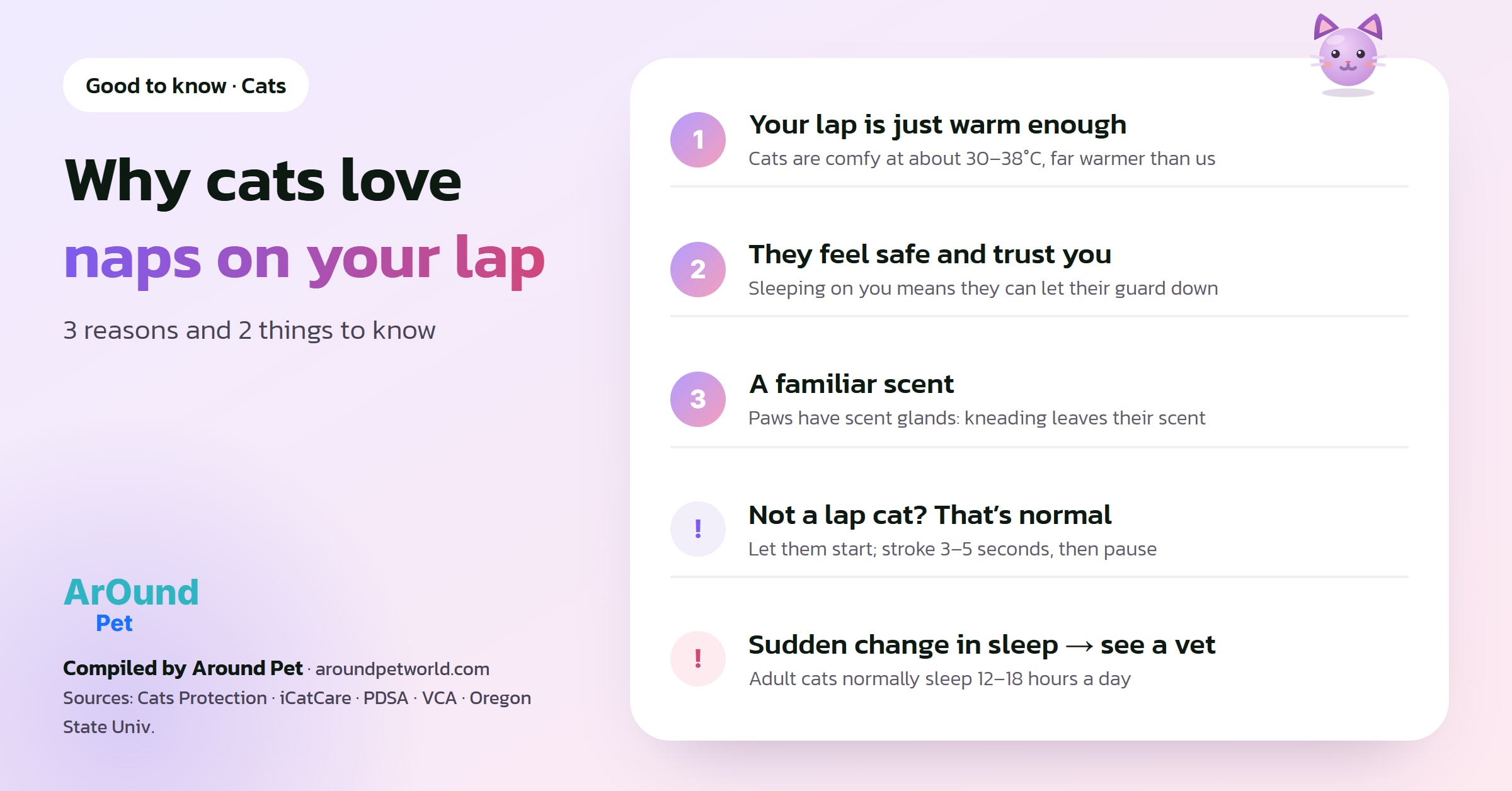
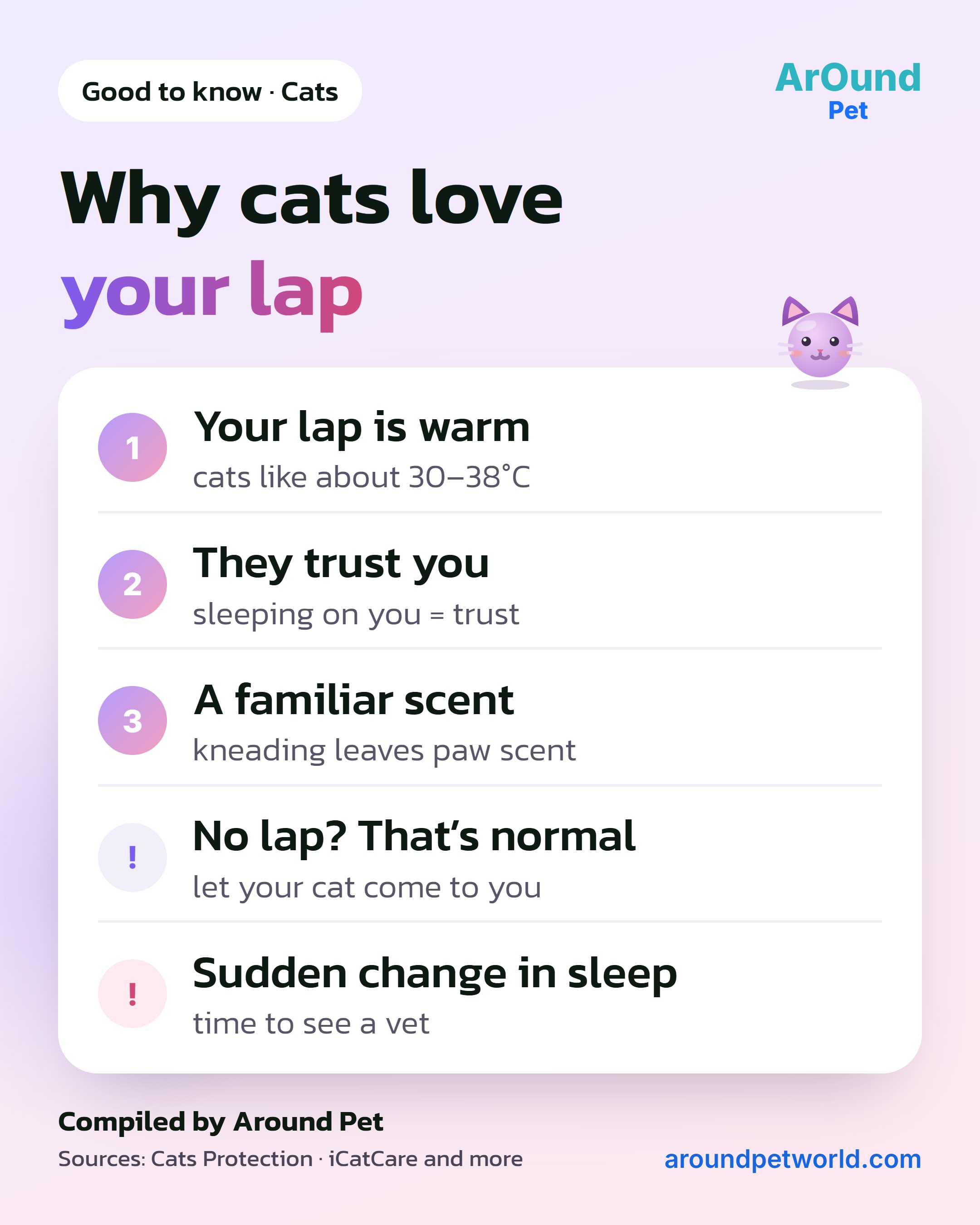
The most straightforward reason is warmth. Our bodies give off heat all the time, so a lap or a chest is like a favourite hot-water bottle to a cat.2
Domestic cats descend from desert ancestors, so they are comfortable at temperatures well above what most people find comfortable. The range where a cat’s body spends no extra energy keeping its temperature steady is often quoted as around 30–38 °C, compared with roughly 20–30 °C for dogs.7 Sources vary a little on the numbers, but agree on the picture: cats feel the cold more than we think.
A spot that feels safe
Cats tend to choose spots that are warm, soft, a little off the ground and feel safe. Notably, cats don’t have just one bed: they rotate between several favourite spots around the house.4 Your lap or your bed ticks every box, warm and with a good view of the room.2
Look closely and you’ll see that even with eyes shut, a cat’s ears still twitch or the tail flicks now and then. That’s because cats stay alert to their surroundings even while dozing.4 Falling asleep on you means your cat trusts you enough to let their guard down.
A sign of attachment
Cat welfare organisations see a cat who chooses to sleep on you as likely to trust you and see you as a friend.2 The belief that cats “don’t bond with people” has been challenged by research too.
In a study at Oregon State University, researchers had cats spend 2 minutes with their owner, 2 minutes alone, then reunite. About 64% of kittens and about 66% of adult cats showed secure attachment, using their owner as a source of comfort, close to the roughly 65% seen in human infants.1
Your lap may be both a warm bed and a “secure base” for your cat at the same time.
That said, the study shows cats can bond with their owners. It doesn’t prove that sleeping on a lap is a measure of love: a cat who likes to sleep at a distance can be just as attached to you.
Scent, kneading and purring
A familiar scent
A pillow or clothes you have just got up from aren’t only warm, they smell of you, which your cat knows well.2 Cats also have scent glands in their paws, so kneading may leave their own scent on the bed or on you.6
Kneading before a nap
The left-right paw pressing many people call “making biscuits” starts in kittenhood, when kittens knead their mother while nursing to help the milk flow, which may also trigger the bonding hormone oxytocin. Some adult cats carry on doing it to soothe themselves, and they usually knead people or animals they like. Some knead to soften a sleeping spot before lying down.6
How much sleep is normal for a cat
If it feels like your cat sleeps all day, that’s normal. Cats are hunters who are most active around dawn and dusk, and they recharge with many short naps throughout the day.45
If your cat isn’t a “lap cat”, that’s normal
Most cats don’t like to be picked up or held for long, and a cat who settles on your lap doesn’t necessarily want to be stroked the whole time. Some just want quiet warmth.3 These habits differ from cat to cat, and respecting your cat’s pace is the heart of a good relationship.
Inviting your cat onto your lap, the cat-friendly way
- Let your cat start itSit quietly in a spot your cat likes and wait for them to come over. Jumping onto your lap is often a sign they’re ready to say hello.3
- Stroke briefly, then pauseStroke for about 3–5 seconds at a time, then pause to see if your cat leans in for more.3
- Always leave a way outDon’t hug or hold them in place. Let your cat leave whenever they want.3
Signs your cat wants to get up
- Turning their head away or moving away
- Ears flattened or turned sideways, a tense or crouched body
- A thumping or lashing tail, skin rippling along the back
- Head shaking, licking the nose or lips (not after eating)
If your cat hisses, growls, swats or bites, stop at once. A cat rolling over to show the belly is a trusting greeting, not an invitation to rub the tummy.3
When to see a vet
Sleeping on your lap is usually just sweet, but a clear change from your cat’s usual behaviour can be a sign of illness or stress. Take your cat for a check if you notice these.
Compiled by Around Pet
This article was written afresh by the Around Pet editors from the sources below, as general information for pet owners. It is not a diagnosis or treatment advice. If your pet seems unwell, please see a vet.
Sources
- Vitale, K. R., Behnke, A. C. & Udell, M. A. R. Attachment bonds between domestic cats and humans. Current Biology 29(18), 2019 and Oregon State University’s news summary of the findings (23 Sep 2019)
pubmed.ncbi.nlm.nih.gov/31550468 · news.oregonstate.edu - Cats Protection Why does my cat sleep on me? (2023)
cats.org.uk/cats-blog/why-does-my-cat-sleep-on-me - International Cat Care Handling and interactions (updated 2026)
icatcare.org/articles/handling-and-interactions - Cats Protection Cats and sleep
cats.org.uk/help-and-advice/cat-behaviour/cats-and-sleep - PDSA Why do cats sleep so much? (2022)
pdsa.org.uk/what-we-do/blog/why-do-cats-sleep-so-much - VCA Animal Hospitals Why do cats knead?
vcahospitals.com/resources/behavior-cat/true-or-false-do-cats-knead - American Veterinary Society of Animal Behavior (AVSAB) Can we keep our cats warm enough? (2021)
avsab.org/can-we-keep-our-cats-warm-enough